
Overview
My main research topic is about the accretion of young low-mass stars. This process is itself a research domain but implies numerous side-topic of studies. I am using spectropolarimetric time-series to precisely characterise the accretion process and magnetic field of individual targets, often completed by other techniques such as photometry and interferometry.
Accretion process of classical T Tauri stars
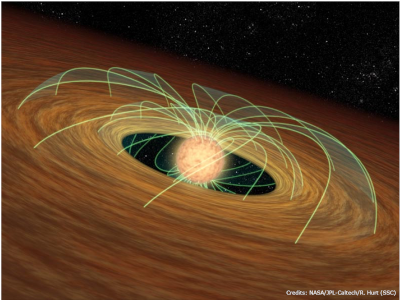
Classical T Tauri Stars (cTTS) are young stellar objects, still surronded by an circumstellar disc from which they accrete material. The magnetic field of these stars is so strong that it will drive the accretion by pulling disc's material outside the disc plan. It force an accretion by folowing the magnetic fields lines, forming the so called accretion funnel flows. This process called magnetospheric accretion process is my main research domain.
Stellar Magnetic field
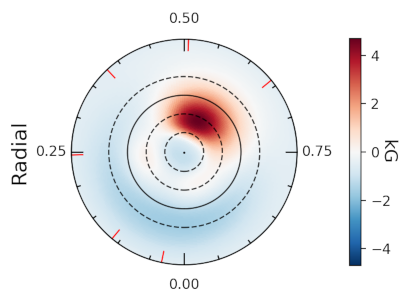
Thanks to the polarisation of the stellar light by the magnetic field, we can extract informations about the magnetic topology of the star from spectropolarimetric time series. Using the method called Zeeman-Doppler Imaging, we can reconstruct maps of the stellar britghtness and magnetic field from mean unpolarised (Stokes I) and circularly polarised (Stokes V) profiles (Least-Squared Deconvolution). These maps are then compared to line profiles and radial velocity modulation to constrain the location and nature of the different structures relevant to the magnetospheric accretion.
Multiple systems' accretion
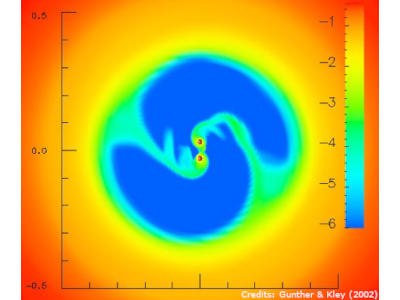
The accretion process of single cTTSs start to be well constrained. However, the magnetospheric accretion scheme cannot be directly applied to multiple systems. This is due to the presence a companion around the primary, distrubing the accretion trough its gravity and its magnetic field. Futhermore, the accretion disc might not surroung only one component of the system. As exemple, a circumbinary disc, surrounding a binary system, might nourrish the accretion of the component, but the two components might accrete as well. In addition, if the orbit is eccentric, the components-disc distance is varying. Other effects have to be taken into account.
Episodic accretion
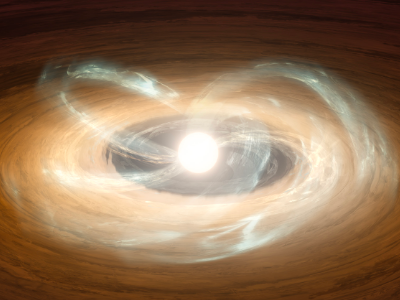
Among cTTSs, some objects are showing strong luminosity bursts and ourbursts, without identified period and without obvious recurrence. These events are ascribed to strong enhancement of the mass accretion rate, which origin is still debated. Several hypotheses exist, implying the stellar magnetic field, disc instabilities, or the effect of a companion. Identifying the origin of these events is one of my research aim.